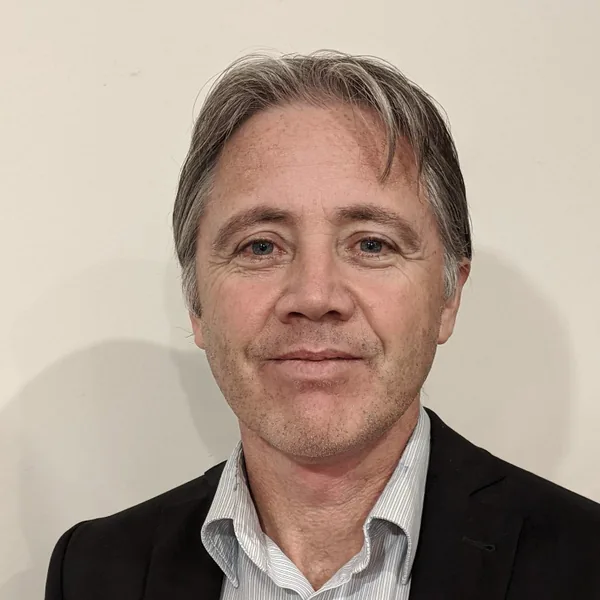
Philip M. Lewis, PhD
Pronouns: he/him, Email: philip dot lewis at monash dot edu
- Affiliated institution
- Former Researcher and Commercialisation Lead (2019 - 2023)Monash University
- Research group
- Monash Vision Group
Philip M. Lewis is a biomedical engineer and neuroscientist whose work spans implantable neural interfaces, cortical visual prosthesesa device intended to create visual percepts by stimulating the visual system, and medical device development and commercialisation.
With an undergraduate background in biophysics and medical instrumentation, Lewis spent 14 years in the Department of Neurosurgery at The Alfred hospital in Melbourne, conducting research on cerebral blood flow, brain monitoring, and traumatic brain injury. He obtained his PhD from Monash University in 2014 with a dissertation on cerebral autoregulation monitoring. He subsequently worked in the medical device industry, gaining experience in regulatory affairs, manufacturing, and research translation.12
Lewis contributed to the Monash Vision Group's development of Gennaris, a wireless cortical visual prosthesisa device that stimulates the cerebral cortex to create sensory percepts designed to restore visual functionthe measurable performance of the visual system through direct electrical stimulationthe use of controlled electric current to activate or alter neural activity of the visual cortex. He has published extensively on the development, history, and clinical challenges of visual prostheses, including influential reviews co-authored with Jeffrey V. Rosenfeld and Arthur J. Lowery.34
In 2019, Lewis led the Cortical Frontiers project, a federally funded initiative to advance the commercialisation of implantable brain–machine interfaces for vision restoration and motor rehabilitation. In 2023, he joined Monash Innovation as Commercialisation Manager for medical technologies, supporting the translation of university research into clinical products.15
Footnotes
-
Monash University: Monash Innovation welcomes new Commercialisation Manager (2023) (opens in a new tab). ↩ ↩2
-
Monash University: Completion of Philip Lewis's PhD (2014) (opens in a new tab). ↩
-
Lewis PM, Ackland HM, Lowery AJ, Rosenfeld JV. Restoration of vision in blindsevere vision loss that may still include some remaining sight individuals using bionic devices: a review with a focus on cortical visual prostheses. Brain Research (2015). doi:10.1016/j.brainres.2014.11.020 (opens in a new tab). ↩
-
Lewis PM, Rosenfeld JV. Electrical stimulation of the brain and the development of cortical visual prostheses: an historical perspective. Brain Research (2016). doi:10.1016/j.brainres.2015.08.038 (opens in a new tab). ↩
-
Monash University: Opening eyes to a frontier in vision restoration (2020) (opens in a new tab). ↩
Experience


Education
Article information
How verification worksVersion 1 (unverified)
Created on by Michael Beyeler. Last updated on by Michael Beyeler.
Authors
- Michael BeyelerAssociate Professor, University of California, Santa Barbara (UCSB)