Tracy J. Putnam
Pronouns: he/him, Born April 14, 1894, Died March 29, 1975
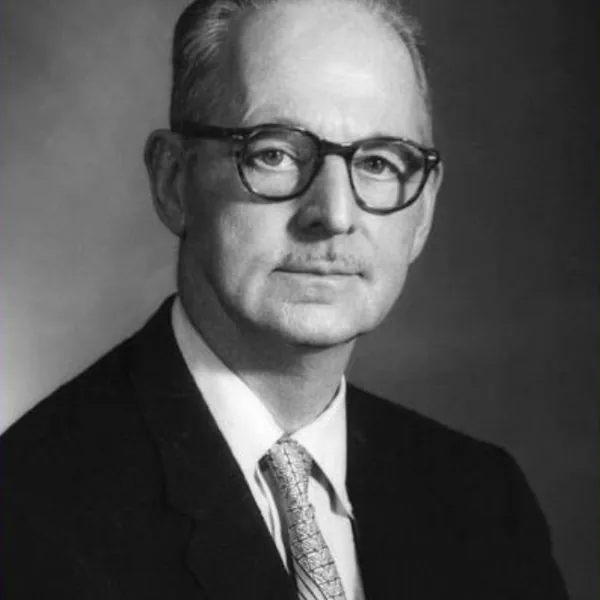
- Inventor of
- Button-Putnam Cortical Prosthesis
Tracy Jackson Putnam (1894–1975) was an American neurologist and neurosurgeon who contributed to the early development of cortical visual prosthesesa device intended to create visual percepts by stimulating the visual system. He graduated from Harvard College in 1915 and Harvard Medical School in 1920, receiving further training in neurology and neurosurgery, including under Harvey Cushing. He subsequently led the neurological service at Boston City Hospital and became chairman of the departments of Neurology and Neurosurgery at Columbia University in 1939.1
Putnam is best known for his discovery, with H. Houston Merritt, of the anticonvulsant properties of phenytoin (Dilantin) in 1938, a landmark in the pharmacological treatment of epilepsy. In 1947, he relocated to California, where he served as Chief of Neurosurgery at Cedars of Lebanon Hospital in Los Angeles until 1958.2
In collaboration with John C. Button Jr., Putnam conducted pioneering experiments in artificial vision using electrodes implanted in the visual cortex of blindsevere vision loss that may still include some remaining sight individuals. Their first experiment in 1957 demonstrated that cortical electrical stimulationthe use of controlled electric current to activate or alter neural activity could elicit visual percepts in a person with long-standing blindness. Their subsequent publication in 1962, Visual Responses to Cortical Stimulationstimulation applied to the cerebral cortex to alter neural activity or evoke a percept in the Blind, was among the earliest clinical reports of a cortical visual prosthesisa device that stimulates the cerebral cortex to create sensory percepts and preceded the development of more sophisticated multielectrode systems by Giles Brindley and W. S. Lewin.3
Footnotes
-
Rowland, L. P. (2009). The Legacy of Tracy J. Putnam and H. Houston Merritt: Modern Neurology in the United States (opens in a new tab). Oxford University Press. ↩
-
California Association of Neurological Surgeons (2022). History of Neurosurgery at Cedars-Sinai (opens in a new tab). ↩
-
Button, J. C. Jr. (1958). Electronics brings light to the blind (opens in a new tab). Radio-Electronics, December 1958; Button, J., & Putnam, T. (1962). Visual responses to cortical stimulation in the blind. Journal of the Iowa State Medical Society, 52, 17–21. ↩
Article information
How verification worksVersion 1 (unverified)
Created on by Michael Beyeler. Last updated on by Michael Beyeler.
Authors
- Michael BeyelerAssociate Professor, University of California, Santa Barbara (UCSB)