Phoenix 99
Suprachoroidal, Electronic, Preclinical
- Institution
- University of Sydney
- Inventor
- Gregg Suaning
The Phoenix 99 retinal implantan implanted electronic device that stimulates surviving retinal neurons to create visual percepts originated from the efforts of Bionic Vision Australia (BVA), a consortium established in 2010 to advance bionic eye technology in Australia. Initially developed within BVA's collaborative framework, the implant was part of a broader initiative to restore vision for individuals with degenerative retinal conditions like retinitis pigmentosaa group of inherited retinal diseases that progressively damage photoreceptors. During its early stages, the implant underwent preclinical testing at UNSW Australia as part of BVA's research program. After BVA's funding concluded in 2016, Prof. Gregg Suaning and his team at the University of Sydney continued to develop the technology, ultimately leading to the Phoenix 99.
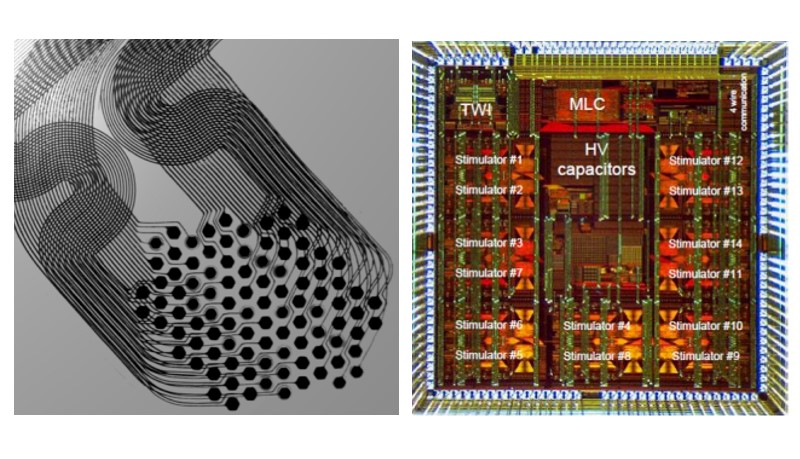
The Phoenix 99 is fully implantable, featuring 99 electrodes arranged in a unique hexagonal mosaic pattern, where each cluster consists of seven electrodes: a central stimulating electrode surrounded by six electrodes that serve as the return path for the current (Layton et al., 2017 (opens in a new tab)). This configuration, known as hexapolar stimulation, effectively limits current spread and reduces "cross-talk" between stimulation sites, allowing multiple hexagons to be stimulated simultaneously. The implant combines this focused activation with a novel 'quasi-monopolar' stimulation (QMP) approach, which concurrently delivers sub-threshold monopolar and low-amplitude hexapolar stimulation to reduce the activation threshold while maintaining focused stimulation. The device’s stimulation circuitry is contained within a hermetically sealed chamber and wirelessly configured by external image processing hardware. Successful preclinical trials have demonstrated its safety and potential efficacy, establishing it as a promising candidate for future clinical testing in human patients.
Video
Device Specifications
- Number of electrodes
- 99
Article information
How verification worksCreated by Ryan Neydavood. Last updated on .
Verified by
- Gregg SuaningProfessor, University of Sydney

Authors
- Ryan NeydavoodFormer Content Creator, bionic-vision.org
- Michael BeyelerAssociate Professor, University of California, Santa Barbara (UCSB)